
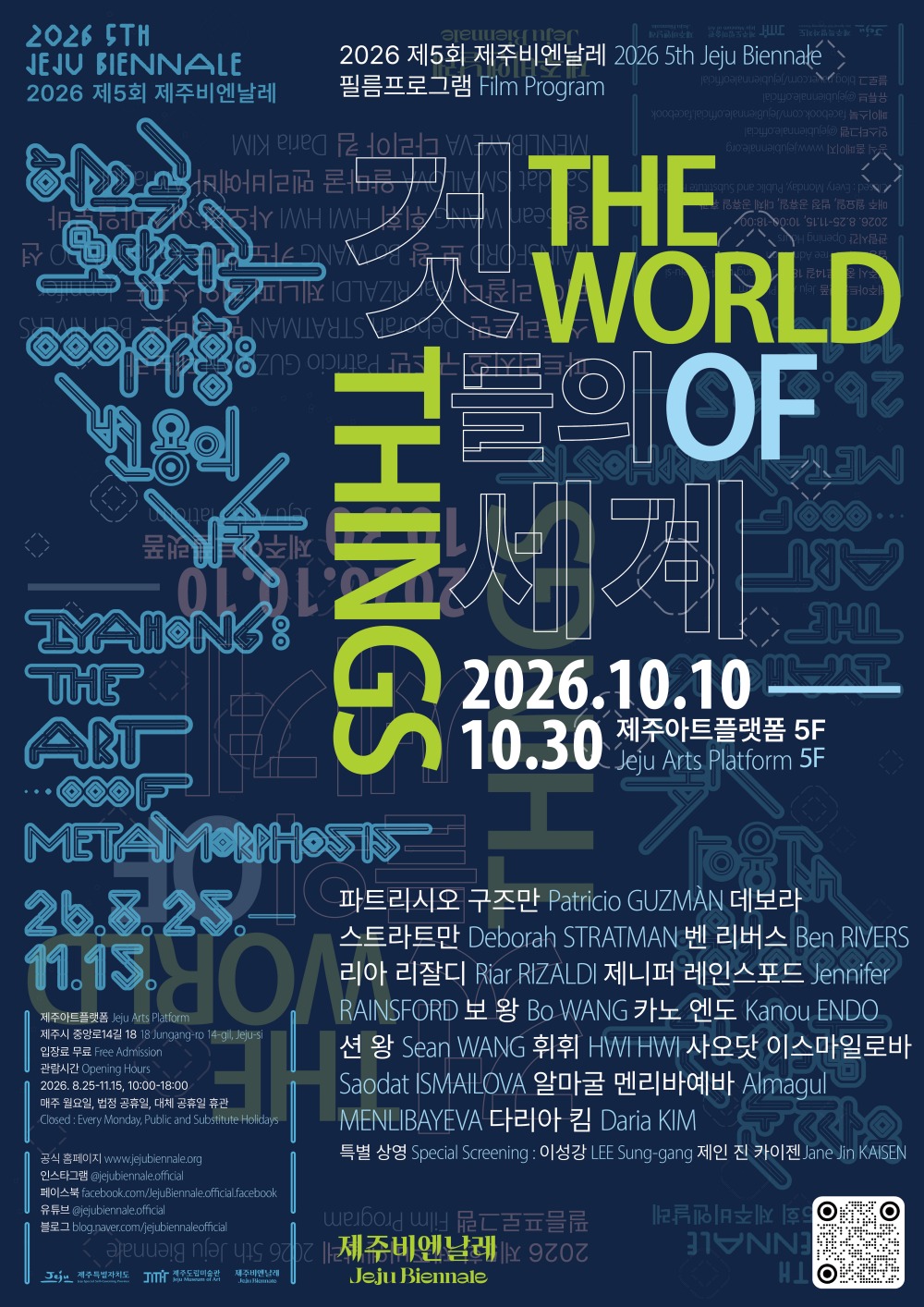
2026 5th Jeju Biennale Film Program
Program
2026 5th Jeju Biennale Film Program
Date
October 10 (Sat) – October 30 (Fri), 2026
Venue
Jeju Arts Platform
Screenings
16 films
Participants Artists
Patricio GUZMÀN, Deborah STRATMAN , Ben RIVERS, Riar RIZALDI, Jennifer RAINSFORD, Bo WANG, Kanou ENDO, Sean WANG, HWI HWI, Saodat ISMAILOVA, Almagul MENLIBAYEVA, Daria KIM
Special Screening
LEE Sung-gang Jane Jin KAISEN
Download
What do the land and the sea—and the “things” that live, gather, and flow there—remember? Is there a way for humans to see, hear, and learn from the memories of these ‘things’? But before that, aren’t humans themselves part of these ‘things’? If so, what should we call the world of these ‘things’?
Following threads of interconnected questions, the Jeju Biennale’s film program ‘The World of Things’ presents sixteen short and feature films produced worldwide. These works transcend mythology, history, and borders. They move fluidly between fiction and non-fiction. Beyond the human perspective, they capture the world through the perceptions of diverse ‘things.’
The screening hall at Jeju Art Platform will become a space where we encounter the light, air, sound, and vibrations these films emit. There, we meet the practices most urgently responding to global crisis. They too will be the most rigorous and beautiful.
 Line Up
1. Patricio GUZMÀN, Nostalgia for the Light
2010 | Chile·France·Germany | Color | 90min.
The first film in Patricio Guzmán's homeland trilogy takes us to Chile's Atacama Desert. There, astronomers study the distant past of the universe, while women search the sand for the remains of relatives who disappeared under the Pinochet dictatorship. The film moves between eyes that read ancient starlight and hands that sift through desert soil, and so holds two very different searches for the past within one landscape. It is a poetic film that asks what remembering the past means for those of us living in the present.
2. Patricio GUZMÀN, The Pearl Button
2015 | Chile·France·Spain | Color | 82min.
Following the waters of Chilean Patagonia, the film traces the lives of the Indigenous peoples who lived with the sea, along with the traces of those who disappeared under the dictatorship. Two buttons from different eras are the thread that ties together histories of colonial rule and state violence. The film moves us from looking at a beautiful landscape to listening for the voices buried within it.
3. Patricio GUZMÀN, The Cordillera of Dreams
2019 | Chile·France | Color | 84min.
Guzmán has lived in exile since leaving Chile. For him, the Andes are the landscape of a distant homeland and also a place of memory he has never been able to leave. Images of the mountains' vast expanse alternate with footage of Chile's pro-democracy protests, and the director's inner life becomes bound up with his country's history. The film sets mountains formed over immense spans of time against a camera that catches passing moments.
4. Riar RIZALDI, Monisme
2023 | Indonesia·Qatar | Color | 117min.
Monisme is a docu-fiction set on Indonesia's Mount Merapi. It looks at how a volcanologist, sand miners and a shaman each relate to the mountain. Moving across documentary, fiction and horror, Riar Rizaldi shows a landscape where science and spiritual belief, resource extraction and violence are tangled together. The film's experimental approach stands out: it asks us to see the volcano not as something to observe or exploit, but as a presence closely tied to human life.
5. Jennifer RAINSFORD, All of Our Heartbeats are Connected Through Exploding Stars
2022 | Sweden | Color | 77min.
After the 2011 tsunami in Japan, people who lost loved ones must learn to live with their grief, and the film follows them through that time. It brings together a man diving into the sea in search of traces of his wife, people collecting debris washed up across the Pacific, and creatures living in the deep ocean. In this way it looks both at the marks left by disaster and at the life that goes on afterward. Its view widens from personal mourning to the ecology of the ocean and the scale of the cosmos. Through links between beings that seem far apart, this essay film explores what loss and recovery mean.
6. Ben RIVERS, Slow Action
2010 | USA | Color | 45min.
Set in a distant future where sea levels have risen sharply, this experimental science fiction visits four isolated islands, each with its own imagined society. Over 16mm footage shot around the world, a narrator reads what sound like records of imagined utopias, so real places become traces of a strange future world. Moving between documentary, ethnography and science fiction, the film invites us to imagine communities after catastrophe and the possibility of utopia.
7. Deborah STRATMAN, Last Things
2023 | France·Portugal·USA | Color | 50min.
The film starts by imagining the life and matter that will carry on after humans are gone. It looks at evolution and extinction from the point of view of rocks and minerals, exploring a history of the Earth far longer than human time. Images range from tiny crystals to vast landscapes and are woven together with geological explanation and science-fiction storytelling. The result is an original experiment in cinema.
8. Kanou ENDO, God in a Military Uniform
2025 | Japan | Color | 107min.
In Taiwan, some Japanese soldiers are worshipped as gods. To find out why, director Kanou Endo and anthropologist Yohei Fujino visit places where memories of colonial rule and war meet folk religion. They meet Taiwanese residents who comfort the spirits of the dead, and Japanese descendants who are reunited with ancestors who have become gods. Through these meetings of different histories and beliefs, the film shows how honoring the dead can create new relationships between past and present, and between Taiwan and Japan.
9. Sean WANG, A Marble Travelogue
2022 | France·Greece·Hong Kong·Netherlands | Color | 99min.
This travelogue follows goods moving between East and West to reveal the contradictions and ironies of the global economy. It traces marble from quarries in Greece to processing plants in China and back to Europe. Along the way it meets a Chinese businessman who bought a quarry and traders from many countries. The film shows a marble industry being rebuilt around China, which is now both a huge production base and a major consumer market.
10. Bo WANG, An Asian Ghost Story
2023 | Hong Kong· Netherlands | Color | 37min.
This cinematic fable begins with Hong Kong's wig industry in the 1960s. It explores the histories of the Cold War and Asian modernization tied up in human hair traded across borders. A female ghost living in a wig drifts between Asia and the United States, and through her story the film shows how memories of colonial rule and transnational exchange travel with these goods. Its unusual form, part essay and part docu-fiction, is equally compelling.
11. HWI HWI, fotofiction
2026 | Korea | Color | 35min.
Hwi Hwi, a visual artist from Jeju, uses photography and video to archive objects that come from the land of the island, and then lays them out again on the cinema screen. The analog film that carries them is not so much an experiment as the most direct and concentrated way to pass on the things that came from the island, and the light that is their trace. Yet the work is more than a record, because of the beautiful, flowing language the artist speaks alongside silent people and the sounds of nature. Through it, we watch something come into being: a history of Jeju and a testimony to it, and at the same time a fiction that leaves Jeju only to come back.
12. Saodat ISMAILOVA, Amanat
2026 | Uzbekistan | Color | 36min.
Set in the walnut forests of Kyrgyzstan, Amanat explores how cultural identity has been reshaped since the collapse of the Soviet Union, through old legends and the spiritual life of the forest. A man falls asleep in the forest, and his journey is layered with oral myths and visions. In dreamlike images, the film shows the real limits on who owns the land and who may enter sacred places. It lets us feel, in our bodies, the life of the forest and the weight of historical change. It asks how the memories held in landscapes and stories can be protected and handed down, even after rupture and loss.
13. Almagul MENLIBAYEVA, Exodus
2009 | Kazakhstan | Color | 11min.
Kazakh visual artist Almagul Menlibayeva shows nomads who must give up their traditional way of life and move into a new, modern world. Against the cold, plain sight of furniture being loaded onto trucks, women perform surreal rituals, spreading their long hair like wings to stop the departure. Electronic sound and black-and-white imagery create a strange sense of distance. The film conveys a cultural identity caught between old traditions and rapid modernization.
14. Daria KIM, 1937
2025 | Uzbekistan | Color | Animation | 16min.
This video work looks back at the Koreans whom Stalin's government forcibly moved from the Russian Far East to Central Asia in 1937. The director, who is Koryo-saram herself, turns paintings by Koryo-saram artists in Uzbekistan into animation. By adding movement and sound to still pictures, she brings the history of this migration into the present. The work is a strong example of how a community forced from its homeland can keep its memory alive in art and pass it on.
Special ScreeningLEE Sung-gang, O-nu-ri
2003 | Korea | Color | Animation | 16min.
Based on a Jeju myth, this short animation follows a girl taken from Woncheongang, the land where the seasons begin, on her way back home. It uses the colors and shapes of traditional Korean folk painting (minhwa) to show a mythical world. The people she meets on her way home make it a warm, playful fable about fate and attachment.
Jane Jin KAISEN, Burial of this Order
2023 | Denmark | Color | 25min.
At an abandoned resort on Jeju Island, artists, activists, migrants and minorities hold a funeral procession. They carry a coffin behind a black mirror instead of a memorial portrait, while dokkaebi (Korean goblins) appear beside them and wind and rain sweep through. In this group performance they try to bury an order that creates hierarchy and division, and the work imagines new relationships and communities growing out of the ruins.
Sidebar EventsDirector’s Talk_1 : HWI HWI, fotofiction
Oct 17(Sat), 2 PM
Director’s Talk_2 : Kanou ENDO, God in a Military Uniform
Oct 25(Sun), 2 PM
Lecture_1 : Un-seong YOO(Film Critic), Patricio Guzmánand his works
Oct 10(Sat), After the Screening of The Pearl Button
Lecture_2 : HEO Nam Choon(Mythologist), A Jeju Myth and O-nu-ri
Oct 11 (Sun), 2 PM, After the Screening of O-nu-ri
Program Talk_1 : KANG Jin-seok(Programmer), The History of Things: Wandering, Gathering, Transforming
Oct 18 (Sun), 2 PM, After the Screening of All of Our Heartbeats are Connected Through Exploding Stars
Program Talk_2 : KANG Jin-seok(Programmer), Central Asia: At the Crossroads of History, Mythology, and Art
Oct 24 (Sat), 2 PM, After the Screening of Amanat, 1937
ListOct 17(Sat), 2 PM
Director’s Talk_2 : Kanou ENDO, God in a Military Uniform
Oct 25(Sun), 2 PM
Lecture_1 : Un-seong YOO(Film Critic), Patricio Guzmánand his works
Oct 10(Sat), After the Screening of The Pearl Button
Lecture_2 : HEO Nam Choon(Mythologist), A Jeju Myth and O-nu-ri
Oct 11 (Sun), 2 PM, After the Screening of O-nu-ri
Program Talk_1 : KANG Jin-seok(Programmer), The History of Things: Wandering, Gathering, Transforming
Oct 18 (Sun), 2 PM, After the Screening of All of Our Heartbeats are Connected Through Exploding Stars
Program Talk_2 : KANG Jin-seok(Programmer), Central Asia: At the Crossroads of History, Mythology, and Art
Oct 24 (Sat), 2 PM, After the Screening of Amanat, 1937